HSK 3.0
The characters behind HSK 3.0 levels 1-3
Words are built from characters, and the same characters come back again and again. We counted the characters in HanziBook's HSK 3.0 level 1, 2 and 3 word lists, to show how many you need, which ones matter most and how much of level 3 you already know.
The short answer
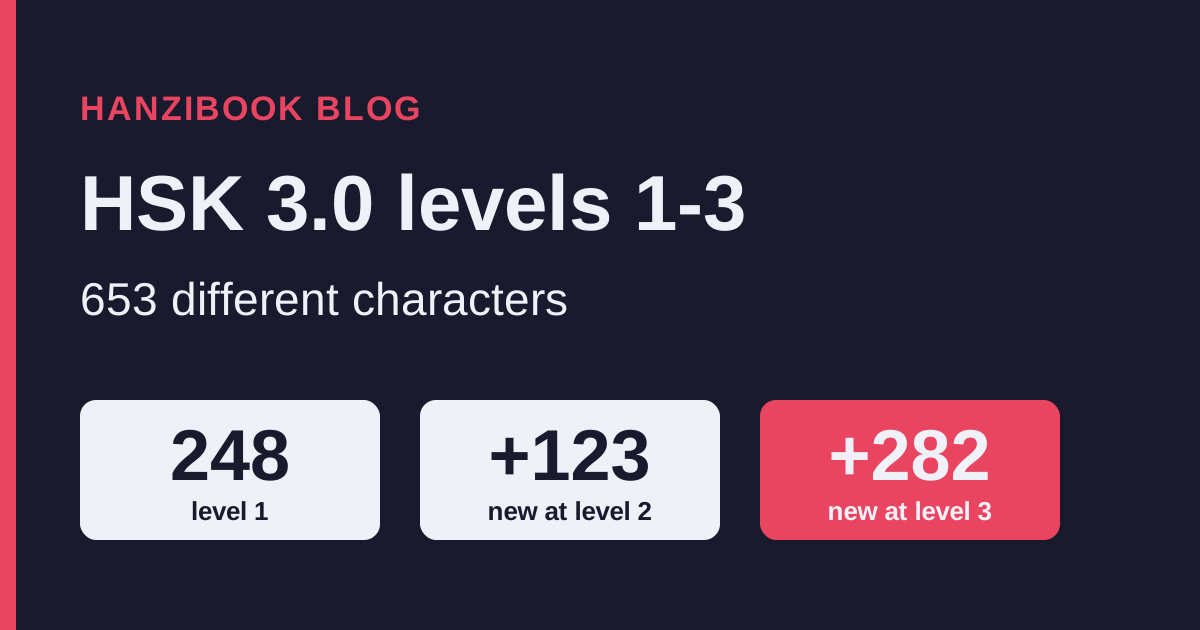
In HanziBook's data, HSK 3.0 levels 1 to 3 hold 978 words written with 653 different characters. Level 1 needs 248 characters, level 2 adds 123 new ones and level 3 adds 282. Only 140 of the 487 level 3 words (28.7%) use characters you already met in levels 1 and 2.
The counts per level
We used HanziBook's HSK 3.0 lists, which give each word at the level where it first appears. A character is counted at the first level where it shows up in a word, so a character that returns later is not counted twice in the running total. The lists were read on 5 November 2026.
| Level | Words | Characters used | New characters | Running total |
|---|---|---|---|---|
| HSK 3.0 level 1 | 294 | 248 | 248 | 248 |
| HSK 3.0 level 2 | 197 | 199 | 123 | 371 |
| HSK 3.0 level 3 | 487 | 473 | 282 | 653 |
| Levels 1-3 | 978 | 653 | 653 | 653 |
Level 3 is the big step. It has 487 words, almost as many as levels 1 and 2 together (491), and it brings 282 new characters against 123 at level 2.
The 30 characters in the most words
Some characters do far more work than others. This table counts the different words in levels 1-3 that contain each character, with the split by level. 子 (zi) comes first: it is in 21 words.
11 characters are in 8 words each, so 6 of them are left off this list. The full list is in the CSV below.
| # | Character | Meaning | Words at level 1 / 2 / 3 | Total words |
|---|---|---|---|---|
| 1 | 子 (zi) | child / son / (noun suffix) | 7 / 4 / 10 | 21 |
| 2 | 学 (xué) | to learn; to study | 12 / 1 / 5 | 18 |
| 3 | 上 (shàng) | up / above / on | 7 / 6 / 3 | 16 |
| 4 | 生 (shēng) | (no entry of its own; appears in 16 words) | 7 / 1 / 8 | 16 |
| 5 | 儿 (ér) | (no entry of its own; appears in 15 words) | 9 / 4 / 2 | 15 |
| 6 | 天 (tiān) | sky / heaven / day / weather | 7 / 0 / 8 | 15 |
| 7 | 一 (yī) | one | 4 / 2 / 7 | 13 |
| 8 | 不 (bù) | not / no | 4 / 2 / 7 | 13 |
| 9 | 面 (miàn) | face / side / surface / noodles | 2 / 7 / 3 | 12 |
| 10 | 人 (rén) | person / people | 2 / 0 / 9 | 11 |
| 11 | 好 (hǎo) | good / well | 5 / 2 / 4 | 11 |
| 12 | 小 (xiǎo) | small / little | 5 / 3 / 3 | 11 |
| 13 | 开 (kāi) | open / drive / start | 2 / 3 / 6 | 11 |
| 14 | 有 (yǒu) | have / there is | 5 / 2 / 4 | 11 |
| 15 | 机 (jī) | (no entry of its own; appears in 11 words) | 2 / 2 / 7 | 11 |
| 16 | 来 (lái) | come | 1 / 7 / 3 | 11 |
| 17 | 年 (nián) | year | 4 / 1 / 5 | 10 |
| 18 | 边 (biān) | side; edge | 4 / 3 / 3 | 10 |
| 19 | 下 (xià) | down / below / under | 5 / 3 / 1 | 9 |
| 20 | 中 (zhōng) | middle / center / China | 5 / 1 / 3 | 9 |
| 21 | 出 (chū) | go out / exit | 1 / 5 / 3 | 9 |
| 22 | 到 (dào) | arrive / reach | 1 / 0 / 8 | 9 |
| 23 | 大 (dà) | big / large | 4 / 0 / 5 | 9 |
| 24 | 车 (chē) | vehicle / car / cart | 4 / 3 / 2 | 9 |
| 25 | 方 (fāng) | (no entry of its own; appears in 9 words) | 0 / 0 / 9 | 9 |
| 26 | 以 (yǐ) | (no entry of its own; appears in 8 words) | 1 / 1 / 6 | 8 |
| 27 | 关 (guān) | close / shut / concern | 1 / 0 / 7 | 8 |
| 28 | 去 (qù) | go | 2 / 6 / 0 | 8 |
| 29 | 后 (hòu) | back / behind / after | 1 / 1 / 6 | 8 |
| 30 | 外 (wài) | outside / foreign / external | 2 / 2 / 4 | 8 |
5 of these 30 have no entry of their own in the word lists, so no meaning is given for them: 生 (shēng), 儿 (ér), 机 (jī), 方 (fāng), 以 (yǐ). They only ever appear inside longer words, so the table says where they appear and nothing more. Their pinyin comes from HanziBook's character index.
How much of level 3 you already know
Level 3 has 487 words. Of those, 140 (28.7%) are written only with characters from levels 1 and 2: you know every character in them already, and only the word is new. The other 347 contain at least one character you have not seen.
Look closer at those 347: 272 of them have exactly one new character, so most of the word is familiar. Across the whole level, 473 different characters appear in level 3 words, 191 of them already met earlier and 282 brand new.
Level 2 against level 1 looks much the same: 57 of its 197 words (28.9%) use level 1 characters only.
What it means for study
Learn the characters that open the most words first. The first characters in the table above are the best early investment, because each one turns up in many words and the second meeting is easier than the first.
Learn words, not isolated characters. When a level 3 word has one new character and two you know, you only have to add one shape, and the known characters carry the sound and part of the meaning. Reading a new word as a puzzle of known parts is faster than memorising it whole.
Plan for level 3. It is the largest step in the data, so spread its 282 new characters over weeks rather than days. Revisit the level 1 and 2 characters often, because level 3 words are built from them.
Write the characters as well as reading them. Read how to learn Chinese characters, check the stroke order rules, browse every character in the character index, and practise with the free HSK 3.0 level 1 copybook.
Download the data (CSV)
Every character in levels 1-3, with its pinyin, meaning (where it has an entry of its own), the level where it first appears and the number of words it is in at each level, is in one spreadsheet file: Download the data (CSV).
The file is UTF-8 with a header row, one line per character, 653 lines in all. It opens in any spreadsheet program.
Free to use. Please link to this page if you publish it.
Frequently asked questions
How many characters are in HSK 3.0 levels 1-3?
653 different characters in HanziBook's lists: 248 at level 1, 123 more at level 2 and 282 more at level 3. Together they make up 978 words.
Which character is in the most words?
子 (zi) is in 21 words across levels 1-3. Next come 学 (xué) in 18 words, and 上 (shàng) and 生 (shēng) with 16 each.
How much of HSK 3.0 level 3 do I already know if I finished levels 1 and 2?
You know every character in 140 of the 487 level 3 words (28.7%). 272 more words have just one new character. The rest have two or more.
Comments
Join the discussion after the page loads.