HSK 3.0
The most common radicals in HSK 3.0 levels 1-3
Most Chinese characters have a radical, a part that helps you look them up and often hints at the meaning. We looked up the radical of every character in HanziBook's HSK 3.0 level 1, 2 and 3 lists and counted them, so you know which radicals to learn first.
The short answer
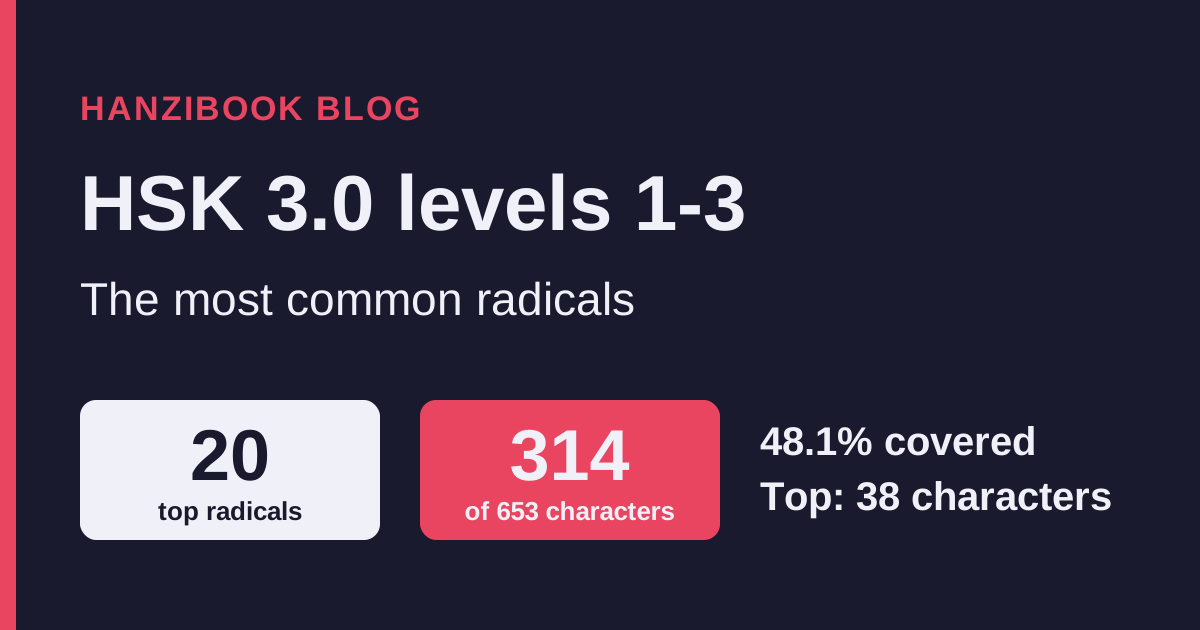
In HanziBook's data, the 653 different characters in HSK 3.0 levels 1 to 3 use 151 radicals. The 20 most common cover 314 characters (48.1%). The most common is 口 (kǒu), meaning mouth, with 38 characters, then 亻 (rén), person, with 26, and 木 (mù), tree; wood, with 24.
How we counted
We took every different character in HanziBook's HSK 3.0 level 1, 2 and 3 word lists (653 of them, read on 5 November 2026) and looked up its radical in HanziBook's character index. Each character is filed under one radical, so each is counted once. Side forms such as 亻 (rén) for 人 (rén) are grouped with their radical and shown in the form most used in our data.
151 radicals appear at least once, and 48 of them appear in a single character only. The top 5 radicals cover 130 characters and the top 10 cover 212. 1 more radical has the same count as number 20 (9 characters) and is left off the table; it is in the CSV.
The radical data comes from Make Me a Hanzi (https://github.com/skishore/makemeahanzi, itself derived from Unihan and CJKlib), licensed under the GNU Lesser General Public License v3 or later. Radical names and notes are HanziBook's own, and each radical links to its page in the character index.
The top 20 radicals
Each row gives the radical with its pinyin (a link to its page), its meaning, how many of the 653 characters use it, and three example characters. The examples are the characters met earliest in HSK 3.0, simplest first.
| # | Radical | Meaning | Characters | Examples |
|---|---|---|---|---|
| 1 | 口 (kǒu) | mouth | 38 | 口 (kǒu), 只 (zhǐ), 叫 (jiào) |
| 2 | 亻 (rén) | person | 26 | 人 (rén), 什 (shén), 今 (jīn) |
| 3 | 木 (mù) | tree; wood | 24 | 本 (běn), 机 (jī), 条 (tiáo) |
| 4 | 忄 (xīn) | heart | 21 | 忙 (máng), 怎 (zěn), 息 (xī) |
| 5 | 氵 (shuǐ) | water | 21 | 水 (shuǐ), 汉 (hàn), 没 (méi) |
| 6 | 讠 (yán) | speech | 20 | 认 (rèn), 识 (shí), 话 (huà) |
| 7 | 扌 (shǒu) | hand | 19 | 手 (shǒu), 打 (dǎ), 找 (zhǎo) |
| 8 | 辶 (chuò) | walk | 16 | 边 (biān), 还 (hái), 这 (zhè) |
| 9 | 一 (yī) | one | 14 | 一 (yī), 七 (qī), 三 (sān) |
| 10 | 女 (nǚ) | woman | 13 | 女 (nǚ), 奶 (nǎi), 她 (tā) |
| 11 | 纟 (mì) | silk | 13 | 系 (xì), 给 (gěi), 红 (hóng) |
| 12 | 宀 (mián) | roof | 12 | 它 (tā), 宜 (yí), 客 (kè) |
| 13 | 日 (rì) | sun; day | 12 | 日 (rì), 早 (zǎo), 时 (shí) |
| 14 | 八 (bā) | eight; divide | 10 | 八 (bā), 公 (gōng), 六 (liù) |
| 15 | ⺮ (zhú) | bamboo | 10 | 第 (dì), 笑 (xiào), 笔 (bǐ) |
| 16 | 刂 (dāo) | knife | 9 | 分 (fēn), 到 (dào), 前 (qián) |
| 17 | 土 (tǔ) | earth | 9 | 在 (zài), 坐 (zuò), 块 (kuài) |
| 18 | 火 (huǒ) | fire | 9 | 火 (huǒ), 点 (diǎn), 热 (rè) |
| 19 | 目 (mù) | eye | 9 | 看 (kàn), 真 (zhēn), 睡 (shuì) |
| 20 | ⺼ (ròu) | meat; body | 9 | 能 (néng), 脑 (nǎo), 肉 (ròu) |
What it means for study
Start with the radicals at the top. The 5 most common cover 130 of the 653 characters, so a few minutes with them pays off across many words. Learn each radical with its meaning and one or two example characters, not as an isolated shape.
Use radicals as a memory aid, not a rule. A radical often hints at the meaning, but it does not always, and it does not give the sound. Treat the hint as a way to attach a new character to something you already know.
Look characters up by radical when you meet one you cannot read. Count the strokes of the radical, find it in the character index, and the page lists every character that uses it.
Read the guide to Chinese radicals for how radicals work, learn how to learn Chinese characters, and check the stroke order rules before you write them. The free HSK 3.0 level 1 copybook gives you writing practice for the first words.
Download the data (CSV)
The full data is in one spreadsheet file, with one line per character: its radical, the radical's pinyin and meaning, how many characters share that radical, the radical's rank, the character with its pinyin and meaning, the level where it first appears and its stroke count: Download the data (CSV).
The file is UTF-8 with a header row and 653 lines of data. It opens in any spreadsheet program.
Free to use. Please link to this page if you publish it.
Frequently asked questions
What is the most common radical in HSK 3.0 levels 1-3?
口 (kǒu), meaning mouth, with 38 of the 653 characters. 亻 (rén) (person) is second with 26 and 木 (mù) (tree; wood) is third with 24.
How many radicals do I need for HSK 3.0 levels 1-3?
The characters use 151 radicals in all, but 48 of them appear in only one character. The 20 most common cover 314 characters (48.1%), which is the place to start.
Does the radical tell me how to say a character?
No. The radical is a way to sort and look up characters and often gives a clue to the meaning. It does not give the pronunciation, so learn the pinyin with each character.
Comments
Join the discussion after the page loads.